It's
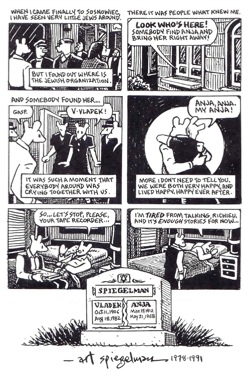
no secret that lines and stripes play a constant role throughout both book one
and book two of Art Spiegelman's Maus, with
the most obvious giveaway in the holocaust's prisoner attire of blue and white
stripes, which became more popularly known after the book and movie The Boy in the Striped Pajamas by
John Boyne. However, we see lines continuously among Speigelman's sketches.
Among the walls and furniture of the post-holocaust scenes also continuously
shows the motif of lines. Thus, it seems that the lines and stripes symbolize
more than just the status of a current prisoner of war. The furniture and walls
can be interpreted that Vladek never truly escapes the war. He is forever
enclosed in a prison until his death, where even in the last scene he is surrounded
by a constant pattern of stripes among his death bed. Two scenes above it is
one of a few rare scenes where stripes do not have much significance in the
block, showing how only in times of pure joy can the holocaust be pushed away.
However, this only lasts a mere few moments, as obviously the stripes returns.
Vladek, unfortunately, takes the haunting of his stripes to his grave.
Sunday, April 19, 2015
Sunday, April 5, 2015
A (donut)Hole in Maus
I found myself continuously surprised as I was reading the
first two chapters. For example,
On “we weren’t close” on page 11:
Without the caption, I
would assume Art and his father are the best of friends. Both of their
expressions are of such happiness and their arms are all open for an embrace.
It’s not only that Art’s father says that “[he] was worried”, but more so that
he was willing to say it. Not only does he sound like a caring father that has
a strong relationship with his son, but the fact that he was willing to admit
anything that “goes against” the pride of a man means a lot. When I studied the
art after reading the text, it was hard for me to put them together in my head.
This got me thinking: Is
art ever really telling from experience? It’s obvious that his
illustrations and secondhand storytelling is not a direct source from the
author himself. He is telling a story of a story—there is always room for error
in this equation. However, even in the scenes where Art is in conversation with
his father, the illustrations are not a direct translation from his memories.
Art illustrates the scenes from an omniscient viewpoint. In reality, Art can
only see so much of the room, his father, and barely anything of himself. Art
is inferring his own expressions, and probably many of the intermediate actions
of his father which don’t hold much significance in real life but could
probably be analyzed down to the core in an 11 AP class. Art was probably busy
jotting down notes while his father was telling his story while counting his
pills or biking. We must remember while reading this novel that the text is
told in first person, but the illustrations are not.
Sunday, March 29, 2015
A Sweet-tooth For Complexity
School is weird—five out of seven days of the week,
toddlers, children, and teenagers alike all go to school to eat the weird food
and learn the weird material. In art/photography class, the teacher tells her
students to paint a landscape or take a photograph so vivid that it tells a
story. After working through blood, sweat, and tears, the same students pack
their bags and shuffle along to English class, where the teacher tells the same
students to write a story so incredibly vivid that it paints a picture or
captures an image in the heads of the reader. It’s humorous how the subjects
that we learn all involve something that they are not, and in this way, they
are beautifully poetic or engagingly complex. Art involves storytelling,
English involves painting, mathematics involves letters…the list goes on.
Now when one tries to combine these abstract complexities
into a more logical way of understanding, perhaps…oh, I don’t know, a graphic
novel (?!?!?!?!?)…it is considered childish or “not real literature”. Simply
because graphic novels usually involve easier understanding does not correlate
to a noncomplex idea or expression, as many may seem to believe. After all, we
are all addicted in some way to the idea of a hidden meaning. So, the words
tell a story, but they also paint a picture. The pictures capture the image,
but they also tell a story of their own. It seems to me that graphic novels do
twice the damage, but all in one blow.
Sunday, March 22, 2015
DoughnutzZzzzzZzzzzzz
The American education system is my life—five out of the
seven days of the week I am in school from 7 AM to 2 PM or later.
It’s funny how the American education system is also the
death of me.
I learned in seventh grade health class (a required course
might I add) that teenagers need eight to ten hours of sleep a night, as they
are in their prime time of growth. However, the National Sleep foundation
reports that only 15% of teens get at least 8.5 hours of sleep per night.
Colleges want kids that do everything. They look for someone who can take heavy
courses in school, then juggle extracurricular programs after school including
clubs, sports, community service, competitions, and a social life to make
connections. However, this is obviously too wordy for the millions of
letters and emails colleges send out every day so instead they euphemize it to “time
management.”
Time management is no longer a term of how quickly you can
finish your activities because there are just some events in scheduling that
the student cannot control. However, teens are able to manipulate their sleep
schedules, so time management is just “who can function the best on the
littlest amount of sleep?”
A lot of homework tonight? Sports right after school, and
band concert in the evening? No problem, we can just sleep tomorrow during class
and pull an all-nighter tonight.
This is the mind of the youth nowadays. But it’s okay, the
bags under my eyes are designer.
Sunday, March 15, 2015
Makin' Some Dough $$$
Laura Brown is the second example of an individual who has
achieved the American Dream but is ultimately unhappy. First is Gatsby, who has
the companion of his wealth, but not the intimacy of companions. Laura, on the
other hand, is not blessed with riches like Gatsby, but she does have a family
including a child and a loving husband. One would think that she is the epitome
of a comfortable woman of middle class suburbia. However, this is all but true,
as she contemplates suicide and ends up running from her family and starting a
new life on her own. This makes me question what “success” truly means. Some
people say that success is when you’ve reached the top of the economy and can
buy anything you can dream of. Other people conclude that all you need is the
love and support of family and friends. Laura had one and Gatsby had the other,
yet neither of them felt successful. Society gave us two different definitions
of success, but I’ve come to realize that neither are true. Every being is
programmed with different needs, so who are we to define success for someone
else? To be happy is to be successful—whether it is money or love or donuts…it’s
really not up to society to generalize.
Sunday, March 8, 2015
(dough)Nuts
“The sun might go in and out, on the tassels, on the
wallpaper, but he would wait, he thought, stretching out on his feet, looking
at his ringed sock at the end of the sofa; he would wait in this warm place,
this pocket of still air, which one comes on at the edge of a wood sometimes in
the evening, when, because of a fall in the ground, or some arrangement of the
trees…warmth lingers, and the air buffets the cheek like the wings of a
bird…her sentence bubbled away…like a contented tap left running.” (144)
During the brief moment when Septimus sees only the products
of reality, Septimus takes notice of the dancing of the sunlight in the room.
Sunlight is usually something that most people take for granted—we see and feel
its effects but don’t think twice about it until the room is dark and cold
again for the night. After not being able to see the purity of ubiquitous
sunlight through the haze of his hallucinations, even the simplest things are
able to content his battered soul.
Septimus is a character that brings new light (ha-pun) to
the book. Unlike other cliché characters from other novels who have a hard time
dealing with reality, Septimus has a hard time finding reality again. His comfort
in anything “so real…so substantial”, even something as simple as Mrs. Peters’
hat and the warmth of the sun’s rays is a sense of comfort to him. Because Septimus
lives in the limbo between reality and his hallucinations, he constantly feels
trapped between the two. Bradshaw proposes to place him in an institution where
now he is not only mentally trapped but physically too. At the time, “the air
buffets the cheek like the wings of a bird.” The bird parallels Septimus, who
is able to fly freely for just a short period of time, similar to how Septimus
was lucid for even just a a brief period.
Sunday, March 1, 2015
No One Wants a P(l)ain Donut...
“’Beautiful!’ She would murmur, nudging Septimus, that he
might see. But beauty was behind a pane of glass. Even taste (Rezia liked ices,
chocolates, sweet things) had no relish to him.” (87)
This short and simple passage is a complete depiction of
Septimus’ perception of his life. Dr. Holmes is only able to understand the
transparency of the glass—he can see the things that Rezia finds beautiful, he
can eat the “ices, chocolates, sweet things” that Rezia likes, but there will
always be something that stops Septimus from perceiving this beauty and from tasting
the ices, chocolates, and sweet things. Rezia fell in love with the Septimus of
who she thought was gentle and sweet (like ices, chocolates…). However, just
like the sweets that graze his taste buds with no effect, Septimus’ marriage
with Rezia “had no relish to him”.
With this passage, I found
a parallel between Mrs. Dalloway and “The
Death of a Moth”.
“Watching him, it seemed as if a fiber, very thin but pure, of
the enormous energy of the world had been thrust into his frail and diminutive
body. As often as he crossed the pane, I could fancy that a thread of vital
light became visible. He was little or nothing but life.” (The Death of a Moth,
2)
In both of these passages, Woolf uses pane as a pun. Both
the pane of glass isolating Septimus and the windowpane trapping the Moth can
also be interpreted as the sources of their pain. The transparency taunts them
with a life they cannot have. Rezia, Dr. Holmes, and Sir Bradshaw are all
ignorant to this barrier between Septimus and his existence.
Subscribe to:
Posts (Atom)