Sunday, May 10, 2015

Donuts Will Ruin Me???

“Orwell feared that what we hate will ruin us. Huxley feared that what we love will ruin us.”
I’m finding it difficult to disagree with either Orwell or Huxley, because I am a victim to both of their statements. In occasion, there are times when I am so overwhelmed with anger or stress that I am blinded by the redness seeping into my vision. Similarly, there also have been times that I’ve had tunnel vision from loving something so much that it affects my judgement and my priorities (ex. Watching trash reality television instead of studying for APs…aka right now, oops).

The problem here is not about loving or hating…it’s about self-control. So I may be a hypocrite (Keeping up with the Kardashians is playing in the background as we speak), but love or hate is not something we can prevent ourselves from feeling. Love and hate may be on the extreme sides of the emotional spectrum, but it’s harder to stay balanced in the middle than to fall to the edge. It is a superpower to be able to stay level headed, even with the world of media circulating around us, constantly trying to tell us what to think or how to feel.

Sunday, April 19, 2015

Sprinkles Look like Lines, Too

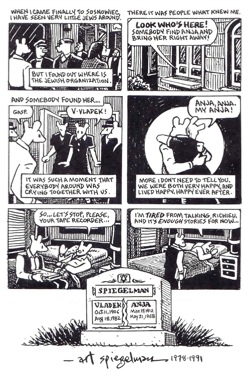
It's no secret that lines and stripes play a constant role throughout both book one and book two of Art Spiegelman's Maus, with the most obvious giveaway in the holocaust's prisoner attire of blue and white stripes, which became more popularly known after the book and movie The Boy in the Striped Pajamas by John Boyne. However, we see lines continuously among Speigelman's sketches. Among the walls and furniture of the post-holocaust scenes also continuously shows the motif of lines. Thus, it seems that the lines and stripes symbolize more than just the status of a current prisoner of war. The furniture and walls can be interpreted that Vladek never truly escapes the war. He is forever enclosed in a prison until his death, where even in the last scene he is surrounded by a constant pattern of stripes among his death bed. Two scenes above it is one of a few rare scenes where stripes do not have much significance in the block, showing how only in times of pure joy can the holocaust be pushed away. However, this only lasts a mere few moments, as obviously the stripes returns. Vladek, unfortunately, takes the haunting of his stripes to his grave. 


Sunday, April 5, 2015

A (donut)Hole in Maus

I found myself continuously surprised as I was reading the first two chapters. For example,
On “we weren’t close” on page 11: 

Without the caption, I would assume Art and his father are the best of friends. Both of their expressions are of such happiness and their arms are all open for an embrace. It’s not only that Art’s father says that “[he] was worried”, but more so that he was willing to say it. Not only does he sound like a caring father that has a strong relationship with his son, but the fact that he was willing to admit anything that “goes against” the pride of a man means a lot. When I studied the art after reading the text, it was hard for me to put them together in my head.

This got me thinking: Is art ever really telling from experience? It’s obvious that his illustrations and secondhand storytelling is not a direct source from the author himself. He is telling a story of a story—there is always room for error in this equation. However, even in the scenes where Art is in conversation with his father, the illustrations are not a direct translation from his memories. Art illustrates the scenes from an omniscient viewpoint. In reality, Art can only see so much of the room, his father, and barely anything of himself. Art is inferring his own expressions, and probably many of the intermediate actions of his father which don’t hold much significance in real life but could probably be analyzed down to the core in an 11 AP class. Art was probably busy jotting down notes while his father was telling his story while counting his pills or biking. We must remember while reading this novel that the text is told in first person, but the illustrations are not. 

Sunday, March 29, 2015

A Sweet-tooth For Complexity

School is weird—five out of seven days of the week, toddlers, children, and teenagers alike all go to school to eat the weird food and learn the weird material. In art/photography class, the teacher tells her students to paint a landscape or take a photograph so vivid that it tells a story. After working through blood, sweat, and tears, the same students pack their bags and shuffle along to English class, where the teacher tells the same students to write a story so incredibly vivid that it paints a picture or captures an image in the heads of the reader. It’s humorous how the subjects that we learn all involve something that they are not, and in this way, they are beautifully poetic or engagingly complex. Art involves storytelling, English involves painting, mathematics involves letters…the list goes on.


Now when one tries to combine these abstract complexities into a more logical way of understanding, perhaps…oh, I don’t know, a graphic novel (?!?!?!?!?)…it is considered childish or “not real literature”. Simply because graphic novels usually involve easier understanding does not correlate to a noncomplex idea or expression, as many may seem to believe. After all, we are all addicted in some way to the idea of a hidden meaning. So, the words tell a story, but they also paint a picture. The pictures capture the image, but they also tell a story of their own. It seems to me that graphic novels do twice the damage, but all in one blow. 


Sunday, March 22, 2015

DoughnutzZzzzzZzzzzzz

The American education system is my life—five out of the seven days of the week I am in school from 7 AM to 2 PM or later.
It’s funny how the American education system is also the death of me.
I learned in seventh grade health class (a required course might I add) that teenagers need eight to ten hours of sleep a night, as they are in their prime time of growth. However, the National Sleep foundation reports that only 15% of teens get at least 8.5 hours of sleep per night. Colleges want kids that do everything. They look for someone who can take heavy courses in school, then juggle extracurricular programs after school including clubs, sports, community service, competitions, and a social life to make connections.  However, this is obviously too wordy for the millions of letters and emails colleges send out every day so instead they euphemize it to “time management.”
Time management is no longer a term of how quickly you can finish your activities because there are just some events in scheduling that the student cannot control. However, teens are able to manipulate their sleep schedules, so time management is just “who can function the best on the littlest amount of sleep?”
A lot of homework tonight? Sports right after school, and band concert in the evening? No problem, we can just sleep tomorrow during class and pull an all-nighter tonight.

This is the mind of the youth nowadays. But it’s okay, the bags under my eyes are designer. 


Sunday, March 15, 2015

Makin' Some Dough $$$

Laura Brown is the second example of an individual who has achieved the American Dream but is ultimately unhappy. First is Gatsby, who has the companion of his wealth, but not the intimacy of companions. Laura, on the other hand, is not blessed with riches like Gatsby, but she does have a family including a child and a loving husband. One would think that she is the epitome of a comfortable woman of middle class suburbia. However, this is all but true, as she contemplates suicide and ends up running from her family and starting a new life on her own. This makes me question what “success” truly means. Some people say that success is when you’ve reached the top of the economy and can buy anything you can dream of. Other people conclude that all you need is the love and support of family and friends. Laura had one and Gatsby had the other, yet neither of them felt successful. Society gave us two different definitions of success, but I’ve come to realize that neither are true. Every being is programmed with different needs, so who are we to define success for someone else? To be happy is to be successful—whether it is money or love or donuts…it’s really not up to society to generalize.


Sunday, March 8, 2015

(dough)Nuts

“The sun might go in and out, on the tassels, on the wallpaper, but he would wait, he thought, stretching out on his feet, looking at his ringed sock at the end of the sofa; he would wait in this warm place, this pocket of still air, which one comes on at the edge of a wood sometimes in the evening, when, because of a fall in the ground, or some arrangement of the trees…warmth lingers, and the air buffets the cheek like the wings of a bird…her sentence bubbled away…like a contented tap left running.” (144)
During the brief moment when Septimus sees only the products of reality, Septimus takes notice of the dancing of the sunlight in the room. Sunlight is usually something that most people take for granted—we see and feel its effects but don’t think twice about it until the room is dark and cold again for the night. After not being able to see the purity of ubiquitous sunlight through the haze of his hallucinations, even the simplest things are able to content his battered soul.
Septimus is a character that brings new light (ha-pun) to the book. Unlike other cliché characters from other novels who have a hard time dealing with reality, Septimus has a hard time finding reality again. His comfort in anything “so real…so substantial”, even something as simple as Mrs. Peters’ hat and the warmth of the sun’s rays is a sense of comfort to him. Because Septimus lives in the limbo between reality and his hallucinations, he constantly feels trapped between the two. Bradshaw proposes to place him in an institution where now he is not only mentally trapped but physically too. At the time, “the air buffets the cheek like the wings of a bird.” The bird parallels Septimus, who is able to fly freely for just a short period of time, similar to how Septimus was lucid for even just a a brief period.


Sunday, March 1, 2015

No One Wants a P(l)ain Donut...

“’Beautiful!’ She would murmur, nudging Septimus, that he might see. But beauty was behind a pane of glass. Even taste (Rezia liked ices, chocolates, sweet things) had no relish to him.” (87)
This short and simple passage is a complete depiction of Septimus’ perception of his life. Dr. Holmes is only able to understand the transparency of the glass—he can see the things that Rezia finds beautiful, he can eat the “ices, chocolates, sweet things” that Rezia likes, but there will always be something that stops Septimus from perceiving this beauty and from tasting the ices, chocolates, and sweet things. Rezia fell in love with the Septimus of who she thought was gentle and sweet (like ices, chocolates…). However, just like the sweets that graze his taste buds with no effect, Septimus’ marriage with Rezia “had no relish to him”.
 With this passage, I found a parallel between Mrs. Dalloway and “The Death of a Moth”.
“Watching him, it seemed as if a fiber, very thin but pure, of the enormous energy of the world had been thrust into his frail and diminutive body. As often as he crossed the pane, I could fancy that a thread of vital light became visible. He was little or nothing but life.” (The Death of a Moth, 2)

In both of these passages, Woolf uses pane as a pun. Both the pane of glass isolating Septimus and the windowpane trapping the Moth can also be interpreted as the sources of their pain. The transparency taunts them with a life they cannot have. Rezia, Dr. Holmes, and Sir Bradshaw are all ignorant to this barrier between Septimus and his existence. 


Sunday, February 8, 2015

I-dough-lize a nutcase???

Sometimes, good people make bad decisions. Victor’s father from “Because my Father Always Said He Was the Only Indian who Saw Jimi Hendrix Play ‘The Star Spangled Banner’ at Woodstock”, however, just seemed to make a lot of them. Some may conclude that he is just a bad person. After all, he “beat the shit out of [a] National Guard private” (Alexie 25), was always out late at night drinking, would leave his family to ride his motorcycle for days on end, and eventually “left [his wife] to finish raising [their son] all by herself” (Alexie 34). So is Daddy Dearest a bad man or just a good man occasionally bad at being good? Victor’s father’s major flaw was that he is selfish, and we all know the selfishness and being a “family man” don’t mix. It is not that he didn’t love his family, but just that he was ignorant to the consequences that others would have to face for his actions. He was also a hero to his son, as he had many admirable traits. Where he lacked consideration, he thrived in passion and adventure. Victor’s father is not a bad man. He may not be the ideal father…well actually not even the ideal member of society, but there is always something you can learn from anybody.

"Yolo is my motto"

Sunday, February 1, 2015

It's Okay If You Don't Like Donuts

The medical world defines disability as a physical or mental condition that limits someone's movements, senses, or activity. 

As hard as this may be to believe, a human is not complete with just a working body and brain. In other words, the definition of disability is true…if we were all computer programmed robots. What about our emotional health? Mental and Emotional health are not the same (I even googled it); mental health includes cognitive thinking and deductive reasoning. Emotional health, on the other hand, includes the acceptance or control of one’s own emotions. One could be an Olympic gold medalist and have an IQ of 160, perhaps the Guinness world record holder of the fastest vegetable dicer while simultaneously reciting all the digits of pi known to mankind, but if he is not emotionally invested in his desire to live instead of to just exist, that technically makes him disabled too.
We are all hypocrites. People throw around phrases like “be yourself”, “you are special”, or “be unique” without truly believing in it themselves. If you can think to look past someone’s taste in music, fashion sense, mode of expression, or religion, then looking past a disability is no different. Nancy Mairs suggests “that we insert disability daily into our field of vision” (Mairs “Disability”), but I believe there’s more to acceptance that exposure, as not all disabilities are observable. Perhaps introspection at our own emotional setbacks can lead us to become empathetic and understanding of disabilities, whether they be physical, mental, or emotional.


Sunday, December 21, 2014

Travis or a Travesty? (Donut)

Adults are strange. Does it become harder to be happy when you grow up? Even things that I thought would bring a smile to anyone’s face couldn’t even seem to make my family lighten up. Grandmama got sad when she became rich with ten thousand dollars, and Daddy was angry when we found out that we were moving into a house! Only mama reacted normally to the house—I didn’t even get a beating that night! However, mama always seems tired, but tries to hide it. I always hear them yelling in the other room when I’m in the other room. I hope everything will change when we move into the new house that Grandmama bought for us, or maybe I’ll be able to go to a room far enough that I won’t have to hear them yelling. Sometimes daddy gets really drunk, but I still love him. “Sometimes when I tell [mama] that I want to be just like [him]—she says she don’t want me to be like that and sometimes she says she does…” (546) I can tell that mama loves him too, though. I guess that loving is hard as an adult, also. I don’t want to ever grow up if it means that I have to worry and be angry all the time too. 

Sunday, December 14, 2014

"But Money = Donuts = Happiness"

“Money can’t buy happiness”, but it can buy a Fitzgerald novel to teach you why this is so. To say that one did not ever once dream of wealth and luxury is something that everyone knows is false. Even from a young age we dove headfirst into stories about princesses rising from rags to riches, unaware that this is “once upon a time”: a time that cannot exist. The direct correlation of happiness and wealth are as real as pink elephants. A common theme among F. Scott Fitzgerald’s literary works, both Dexter and Gatsby find that their desire to have the image of a perfect life—a big house, money in the bank, and the prettiest girl in the city on their arm—turns out to be their tragic flaw. Fitzgerald uses rhetoric such as color symbolism with white, gold, and green to symbolize wealth and purity; however, each are concentrated with irony that is commonly found among satires. Although Fitzgerald’s famous satires take place in the 20th century, the same flaws in human nature and society are still prominent today. Unlike Moses, who may have been able to part the red sea, society is not as able to part its subconscious flaws.  


Sunday, November 30, 2014

The Do's and the Donut's

 What place does a dream/vision have in one's life/relationships? 

As a part-time angsty teenager, I myself am all too familiar with the pondering of existence and the “meaning of life” as I lie awake in the dark at 2 A.M. on a school night.

“Would I be more successful in my journey if I had more motivation?”

“Would I be more dedicated to the journey if I had a set destination?”

I wish I could say that I’ve got it all figured out, but then what fun would that be? However, I have learned that dreams are powerful, but success is dangerous.

Humans tend to work off of the reward system: if we work hard now, we will be rewarded with economic stability/emotional equilibrium/toys from Santa/etc. So it is the incentive that there is a light at the end of the tunnel that keeps us motivated. Those who know exactly what their light looks like are at an advantage. Their vision of success is no longer an abstract concept, but instead a scenario. Gatsby, with the vision of a life with the wealthy and highly demanded Daisy, is able to build himself up from an irrelevant soldier boy to, eventually, the talk of New York.

However, a touch of success is where it becomes dangerous. Success to us is similar to power. A taste of it is enough to throw one off the edge. Eventually, even those that once upon a time had a vision could end up chasing something that will always be an arm’s length away. How one can find success and not fall into its trap is something I’ll save for another night to ponder about. 


Sunday, November 23, 2014

Santa Baby, Slip a Donut Under the Tree

There is not a specific required age at which Santa is revealed to just be one’s parents on a budget and which the stork is actually the birds and the bees, so when do parents decide that the time is right for kids to come out of their bubble of ignorance to face the harsh realities of the “real world”?
My parents were never the type to celebrate the holidays traditionally. I’ve spent most of my thanksgivings at Chinese restaurants because they’re the only ones still open. It’s not surprising that I also never believed in Santa. In third grade, I asked my mom for a Christmas present, as I was jealous of my classmates, who would always boast about their new toys and gadgets after break. My mother told me that I would have to compose to her an email fully in Chinese of my wish list as a tactic of making me practice my Chinese. The email took a good chunk out of my TV time, so you can imagine my excitement when I woke up that Christmas to see boxes underneath the tree. The label said “From, Santa”, but I was no fool. I've seen that wrapping paper hundreds of times in the hallway closet.

Turns out, my mother had actually just re-wrapped the clothes from my closet that she got me from Gymboree on black Friday. However, that’s not the point. Every time I tell someone that my childhood did not include Santa, they look at me with pitying eyes. What they don’t understand is that just because I didn't live off of the ignorant whims of childhood does not mean that mine was not fulfilling. Childhood is not defined by ignorance. Instead, ignorance is prominent in youth because it is just a product of censorship, a parental instinct to protect one’s child from any means of danger. The history teacher from Billy Collins’ poem “[tries] to protect his students’ innocence,” but he just doesn't understand that the truth of reality can also make his students stronger and more grounded. Santa’s missing presence from my life taught me to work for my rewards, even at a young age. 

Sunday, November 16, 2014

d-o-n-u-t DO d)o n(ut) nUt ! O ?t

hi friends this is my bog post about punctuation or in this case the lack thereof after you are finished reading this long sentence please comment below your level of confusion and why
so
does my lack of punctuation leave me with less credibility an impression of an uneducated wannabe author or just an artist with a unique writing style that can convey a deeper meaning than with words alone perhaps a stream of consciousness so rapid that there is no time for , ; . ? !
am I breakingtherulesorjustcreatingnewones
after all
there are no precise rules about punctuation
                                                           Lewis Thomas
I would have typed the whole post like that but then I realized that I actually need two hundred words for a passing grade
anyways
After all weren’t we the ones to create the rules if there are twenty seven amendments to the constitution then what is stopping us from changing the rules of punctuation
Does this make me a poet like Emily Dickinson because my post can be perceived as more art than language
and I gotta say I do feel as if my possibilities are pretty endless right now
I could put a period anywhere between any of these two hundred (or more) words
watch out it could catch you by surprise
what is this mess e.e. cummings       
                  ^beautiful
You are a fool let me strip you of your Harvard degree and the ten awards you received over your lifetime
I mean if you write properly you shouldn’t have to punctuate
                                                                         Cormac McCarthy
An oxford comma huh
may I create my own comma and call it the fan comma
seeing as how neither are technically necessary if embodied in context clues
 My confusion level is 11/10 but not because I don't understand I am just so unfamiliar with the feeling of being so
hipster
.

Sunday, November 9, 2014

The Tastiest Donut

 “We had defended ourselves since memory against everything and everybody, considered all speech a code to be broken by us, and all gestures subject to careful analysis; we had become headstrong, devious and arrogant. Nobody paid us any attention, so we paid very good attention to ourselves. Our limitations were not known to us—not then. Our only handicap was our size; people gave us orders because they were bigger and stronger. So it was with confidence, strengthened by pity and pride, that we decided to change the course of events and alter a human life” (Morrison 191).
Let me just say straight up that I may have fallen asleep once or twice while trying to complete the reading assignments for The Bluest Eye. There have been times that I have looked back at my sticky-notes to realize that this:


Does not make any sense. However, it is passages like this one that make me sit up straighter and my handwriting neater. In the novel, Claudia is nine years old. I don’t remember many specific details of my ninth year of life except for the fact that I would blackmail my dad to tell me where my mom hid my Halloween candy, and I somehow was able to fall off the piano bench while playing piano, causing a nice scar right next to my left eye. Never can I say that I had to wake up or go to bed with such heart-breakingly beautiful perspectives as Claudia. Diction such as “defended”, “headstrong”, “limitations” and “handicap” show that these are not the words of a child, but instead, of a fighter. Childhood is not defined by an age, but by the protection and nurturing environment brought by the parents and the community, the innocent and carefree mindset of an oblivious soul, and the guiltless selfishness that would always be excusable in the end. Claudia, Frieda, and Pecola have none of this. They are forced into maturity to “change the course of events and alter a human life” when they themselves still have to plan out their own course of events. Morrison continues to prove that even a beautiful and eloquent string of words such as this passage has the ability to yank my heart through my chest.


Sunday, November 2, 2014

Straight Hair, Donut Care

In The Bluest Eye, Toni Morrison brings up how women tend to “worry about the edges of [one’s] hair, and how they spend countless hours every year straightening their hair in order to conform to beauty standards. Characters in the novel, such as Pauline, are looked down upon when they don’t straighten their hair to make it resemble Caucasian hair. During our discussion in class, I found this topic incredibly un-relatable. I have stick straight hair—you could say it’s an Asian thing. Ever since I can remember, I’ve always wanted anything but stick straight hair. I dug out my mother’s archaic curling iron the day I learned of such a tool, and even got a perm in seventh grade. So you can imagine my surprise when I started hearing about and seeing girls show up to school with their hair looking very similar to mine, but obviously straightened. I didn’t understand why girls would put effort and sacrifice precious sleep in order to make their hair blander and less individualistic. Now that I better understand the desire to conform to society and the danger of individuality, I understand why girls and women worry about the edges of their hair. But then…why do women curl their hair? It’s alright boys, I don’t understand women either. 


Sunday, October 26, 2014

Donut Blame Barbie

During the years when my age still fell in the single digits, I lived by one rule and one rule alone--never, ever utter the horrendous three Ps--pretty, pink, and princess. I grew up playing with my brother's toys: legos, bionicles, pokemon, and beyblades. I would ride my hotwheels tricycle around the neighborhood, awaiting the day that I could graduate from such childish whims and inherit the big kid transformers themed bicycle and its matching training wheels. A family friend once blessed me with the ever-so-popular Barbie, but my mother quickly learned from her mistake and stuck with giving me my brother's old toys after I continuously stripped Barbie and left her stark naked on the kitchen floor.

Today, tons of sources are attacking the Barbie company for forcing an unattainable goal for body image among young girls. They say that Barbie is the reason that girls are self-conscious, have eating disorders, and are bullied.
However, what about the millions of girls around the word that grew up like me? Never did I ever set foot in that "atrociously" pink isle at my local Toys R Us voluntarily, so, according to the logic of these people who blame the societal flaw of body image on a children's toy, I should have no problem with what I should look like. Wrong.

I do not attain to be Barbie. I do not long for her life, her body, or her lifestyle, but that does not prevent me or any other human being from idealizing what one's body should look like. It's easy for people to put all the blame on one source, especially on sources focused around children and teenagers, simply because our minds are more malleable and easier to manipulate. "Serial killers exist because all the video games are about fighting", or "Girls are prioritizing outer beauty over inner beauty because chick flicks and dolls taught them so" are constantly headers of articles all over the internet. What many don't understand is that correlation does not imply causation (yay stats)--removing Barbie from a child's equation may reduce the rate at which young girls feel the desire to be tall, skinny, and alluring, but it will not eradicate the objectification of women or the desire to meet beauty standards.

Sunday, October 19, 2014

Hypocrisy: Donut Deny

I've always understood that being a hypocrite is a natural thing: it's easy for anybody to watch Honey Boo Boo and say "Wow, they should get off their couch and start doing some stuff that could positively impact the world" when the viewer himself/herself is sitting on the couch watching reality TV. However, the three articles we studied in class this week showed me that our nation and its values are planted in hypocrisy. 


Every Fourth of July, everyone celebrates the work of our founding fathers, including our buddy Thomas Jefferson, for granting us independence. However, the freedom they asked for is not the same as the freedom I have today as an Asian-American. I don’t like the term Asian-American, because my nationality is just American, but for the purpose of my argument, and also in the eyes of our founding fathers, I am Asian-American. Decades after the US became an independent country, our “leaders” still continued to oppress the people of their country. If I had been alive during the time of the Revolution, the nation’s independence would not have granted me freedom, but instead a change in my oppressors. The Declaration is a list of grievances against the King, which, if reworded, could be used against the creators of the document. So, that’s exactly what the feminist movement did. Their document cried of oppression of every kind; their accusations against men seemed endless. Stanton was not mistaken—it is true that the women of the nation at that time were significantly inferior to the men. However, in 1848, when the Declaration of Sentiments was signed, many women were still unafraid to treat their slaves the same way that the men treat them.
All in all, even though centuries have passed and the movement for women’s rights is still ongoing and racism is still prominent in people’s everyday lives, I sure am glad to be alive now instead of back then. 

Sunday, October 12, 2014

I Donut Know Where to Start

Let me just put it out there that reading the end of The Scarlet Letter was infuriating. If there is any literary term for the antonym of Verisimilitude, please let me know, for as of right now, I’m just going to make up my own word for it—TheEndofTheScarletLetter. I could rant for pages, but I’ll just touch up on the basics.


The tragic hero, Dimmesdale, was thoroughly disappointing. Even when he was ignorant and overly pious in the beginning of the novel, at least he had his own backbone. In the scene at the woods, he dared to say “I pray you, if thou hast any means of pacifying the child, do it forthwith! … Pacify her, if thou lovest me!” Words cannot describe how disturbed I was by this dialogue. By taking in Dimmesdale, Hester is basically taking in another child. Does he really think that she’s choosing to have Pearl be this wild rampant of a child (can you tell I dislike Pearl also)?
In the end, when Dimmesdale repents his sin to the community, he decides to just drop dead and leave his family behind. Sure, I understand that his death did have symbolism and that it created dramatic effect and character development, but just because it is the seventeenth century does not allow one to defy the laws of universe and drop dead whenever he pleases! If anything, I thought that revealing his sin would make him stronger in the way that it did for Hester. Dimmesdale is supposedly the tragic hero, but to me, he is the most tragic tragic hero I have ever read about.


I feel as if I’m always super angry after reading an archaic classic; what they used to find beautiful and romantic (i.e. Romeo and Juliet), I just find humorous. It’s a good thing that Hester is a strong, independent woman who don’t need no man. 

A symbolism of Pearl in the modern day society